
Nowadays, technology evolves into something that rapidly changes. The manual approach to doing something also followed suit and turned into an automated system. These occurrences also happen in the cryptocurrency world. Manual trading, which is considered by people a traditional way of trading, is slowly threatened by the existence of automated trading. One of the examples of automated trading is algo trading. Learn algo trading is a way to fully understand algorithmic trading.
This article will focus on giving details of learn algo trading. Start by explaining the definition of algo trading, how it works, the transition from manual trading, risks and benefits, and steps on how to learn algo trading for beginners.
What Is Algo Trading?
As this article mentioned before, algo trading is a way of trading that is included in automated trading. Like its name, algo trading means algorithmic trading, a type of trading that relies on the dynamics of algorithms.
The trade will be automated through certain code or software and will automatically buy or sell the assets. The decision will be based on certain conditions or algorithms that are suitable for the instruction by the asset’s owner at the first time of trade.
In conclusion, algo trading is a trading method that relies on automation and turns a trading strategy into a mathematical language that a computer can understand. After the code is done written and activated, the program will do the job and traders only wait without doing anything but monitoring and optimizing.
How Algo Trading Works
To understand algo trading, it helps to look at a practical example. Manual trading can be done by observing the dynamic price or other factors through a computer, while algorithmic trading will write a set of rules through coding with a form of the algorithm to do this task.
For example, a trader might program their bot with the following instructions:
- Buy 0.5 BTC if the price drops below $60,000 and the 24-hour trading volume exceeds a certain threshold.
- Sell the position immediately if the price rises by 5% (taking profit).
- Sell the position immediately if the price drops by 2% (stopping loss).
Once these rules are set, the software will be running endlessly. It will only do a trade when the market matches these exact conditions.
Also Read: 7 Best Algo Trading Course to Build Smarter Trading Systems in 2026
Core Components of an Algo Trading System
There are some core components of this method that For this automated process to happen seamlessly, an algorithmic trading setup typically relies on three main components:
- The Strategy
The strategy in here refers to instructions and a set of rules that the software/bot needs to know and do. It helps the software to understand the exact time when to buy, when to sell, and how much capital to risk per trade.
- The Trading Bot
It is a trading bot that a trader uses when they want to do algorithmic trading. This is the program that hosts your strategy. It can process real-time market data, do the calculations, and decide to buy or sell in the perfect time.
- The API
API stands for “an application programming interface.” It is a virtual bridge that links a trading bot to a crypto exchange. It receives the command through the trading bot if the criteria are met the conditions that instructed by the traders.
Algo trading will be successful if the combination of the three principles above blends in wisely. This will help investors to participate in the fast-paced crypto markets with a level of speed and precision that human hands simply cannot match.
Transition From Manual to Automated Trading
The modern technology that evolves quickly affected a lot of things, including in the crypto world. The traditional trading relies on manual trading, so all of the buy and sell decisions will be handled by manual steps.
On the other side, automated trading is heavily linked to the trading programs and software to do the task, such as buying or selling assets. The technology is also doing the research work and will decide on a decision based on commands that are instructed in the program or software. This type of trading suits the modern technology that is commonly starting to rely on automated systems and artificial intelligence.
Comparison of Manual vs Automated Trading
The distinction between these two types of trading is very clear. Manual trading relies on humans to make a decision, while automated trading depends on programs and automated systems. The differences will be explained in the table below.
Table 1. Manual vs Automated Trading Comparison
| Feature | Manual Trading | Automated Trading |
| Decision Making | Based on human analysis, feelings, and intuition. | By an automated system that has been commanded certain instructions. |
| Execution Speed | Slower, need time to execute. | Quicker, trade can be done in milliseconds. |
| Emotional Impact | Traders can be influenced by bad emotional factors. | Not affected by emotional subjects, purely doing the programmed instruction. |
| Adaptability | Have high adaptability. | Strict to the code and programmed rules. |
| Consistency | Can be inconsistent because they may deviate and be affected by external or internal factors. | Consistent and stable. Doing the task exactly the same way. |
| Backtesting | It takes more time and diligence to check historical data. | Very efficient because it can access the historical data in seconds. |
The distinction and comparison that have been shown in the table above conclude that automated trading is a more efficient way than manual trading. Those two types of trading have their own respective strengths and weaknesses, but automated trading is growing because it takes less time and is more effective than manual trading.
The automated trading also has more strength than the manual trading. So it gains more interest from traders and drives them to learn algo trade as an effort to understand the automated trading.
Transition from Manual Trading & Growth
Nowadays, traders are starting to have interest in automated trading – including by learn algo trading. The transition is supported by the current era of automated systems, so traders don’t need to work so hard on analyzing or calculating something before doing trading.
This occurrence is pointing out that manual trading is outdated and curious about automated trading, such as learn the algo trading method for traders that have an interest in automated training.
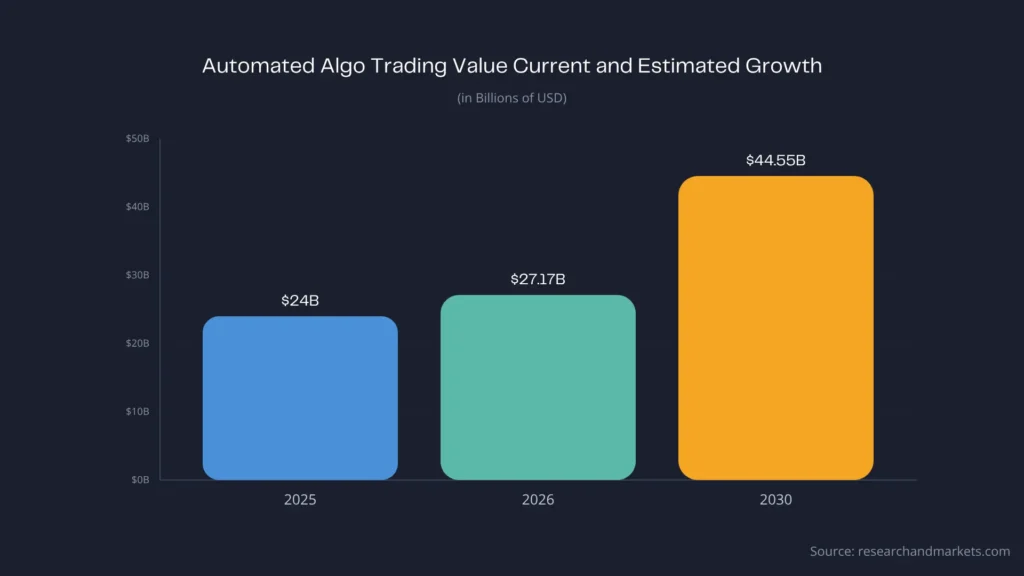
Automated algo trading grows into something bigger year after year. A report from Research and Markets indicates that the automated algo trading market increased by 13.2% from 2025 to 2026. If this percentage rate of growth is stable every year, it can increase into a very big number. For example, if that growth percentage stays, the estimated market value of automated algo trading in 2030 is about US$44.55 billion.
Graph 1. Automated Algo Trading Market Growth
The reason why the automated trading grows rapidly is because it is aligned with the quick change of technological development in the world. Automation became something that a wide audience knew. Traders also start to learn algo trading as an effort to keep up-to-date with the current trends of digital finance.
Automated trading, such as algo trading, is the future face of trading methods. Traders who are starting to expand their knowledge to learn algo trading will benefit from the results in the future.
Also Read: Top 12 Algo Trading Books to Consider in 2026
Risks and Benefits of Algo Trading
All types of trading definitely have their own advantages and disadvantages. Evaluating these two factors is essential for understanding the strength and weaknesses of algorithmic trading in financial markets.
Risks of Algo Trading
The risk of algo trading is a form of disadvantage that traders should look on and decide carefully through it. There are several of them that will be explained below:
- High Reliance on Historical Market Data
Algorithms that are usually applied to algo trading are commonly backtested utilizing historical market behavior. If they use it wisely, this will be a great tool. On the contrary, if traders can’t deal with it carefully, it will be a backfire.
It can happen where a plan suits perfectly with the past market data yet fails to show good development in the current market. This condition occurs due to conditions that previously never happened, such as sudden shifts in volatility or liquidity.
- Expensive Operation Cost
Creating, developing, and maintaining an automated system is an expensive price to pay. The expenses include some bills, such as subscriptions for high-quality, real-time market data feeds, low-latency server hosting, and fees for specialized software or API access.
- Lack of Human Touch
Automated systems are strict with the instructions they receive during the pre-trading process. They can’t translate macroeconomic events, breaking news, or unexpected anomalies.
The lack of human intuition also affects the programs to do something. The algorithm can’t cut the trade during certain conditions due to the previous instructions. This can cost the traders a lot and can lead to potentially severe loss.
Benefits of Algo Trading
- Getting Profit Quick
Algo trading using an automated system so it can maximize the time to do a trade setup. This fast trade decision will also benefit the trader if the strategy and instructions have also been implemented wisely. The benefit
- More Effective Trade
Utilizing an automated system is also helping a trade to make more effective trades. It can be seen by the reduced cost during the trading and perfectly timed regarding the decision to sell and buy.
- Eliminate the Emotional Influence
The emotional influence is a big factor that often causes traders to deviate and do something bad. In algo trading, this kind of occurrence is impossible to happen because it only relies on the instruction it had at the first time.
Get rid of emotional subject will help trader to maximize the profit and minimize the risk of getting a big loss.
Also Read: Retail Algorithmic Trading: How Individual Traders Build and Automate Strategies
Steps to Learn Algo Trading
For newcomers wanting to learn algo trading, there are several steps or tips that should be followed. The steps are a must for individuals who have the drive to learn algo trading and are easy to do but need discipline and consistency.
1. Understanding Crypto Market Fundamentals
A basic understanding of the crypto market is very essential for anyone who wants to learn algo trading. The fundamentals, such as familiarity with technical patterns and price charts is standard practice, as trading algorithms are typically built upon these core market analysis principles.
2. Learn About Algorithmic Trading Strategies
Individuals wanting to learn algo trading need to know about various strategies of algo trading. There are some common strategies someone can explore, such as trend following, mean reversion, market making, and arbitrage strategy. Traders usually will choose the best strategy to comply with their trading plan.
3. Platform Selection and Infrastructure
Choosing the right platform to trade is an important step for anyone wanting to learn algo trading. A great trading platform will ensure the credibility of a good infrastructure in it.
The main factor in how a trader chooses a trading platform is commonly judged by its security, transparency, and platform usability. Access to comprehensive backtesting tools is also a vital feature used to evaluate trading platforms prior to live deployment.
4. Create a Good Trading Plan
Before stepping into the real algo trading, a trader should arrange and set a solid trading plan. Algo trading tends to not be flexible on changing the instruction while the program is running, so planning a trading plan wisely is a must for a trader prior to taking part in algo trading.
These plans define precise parameters, including position sizing, specific entry and exit triggers, and maximum risk limits per trade. Building a trading plan can be challenging, so understanding the fundamentals of the market and strategies is needed.
5. Backtesting and Paper Trading
Backtesting is a method in trading that evaluates trading strategies using historical data to help traders decide how those strategies would have performed in the past. This process allows traders to simulate trades according to real historical market data, ensuring a potential strategy to use in the current or future trading.
Following a backtest, paper trading is commonly utilized. Paper trading is a simulation of trading using virtual assets rather than real money. Paper trading helps traders to understand more about algo trading, although later the trading is only conducted by automated systems.
Combining those two methods will help traders who are still learn algo trading to know more about algo trading principles and how to adapt to real crypto market conditions.
6. Risk Management Implementation
Implementing risk management also happens in algorithmic trading. By applying strict risk management, traders can maximize their profit and minimize the risks of losing a big amount of money.
Systematic risk management is also implemented to prevent rapid capital depletion. Common risk management practices include strict capital allocation limits and programmed stop-loss protocols on every executed trade. Furthermore, asset diversification is frequently used to prevent the impact of sudden price fluctuations in any single asset.
7. Monitoring and Optimization
Although this type of trade utilizes automation, revision and supervision are still needed. Traders can monitor the results and can optimize the trade by doing some other strategy. The dynamic of financial markets is the reason why this thing should be do by traders.
Algorithmic traders routinely monitor system performance, analyze trade histories, and adjust technical parameters to ensure the algorithm remains aligned with current market volatility and trends.
8. Networking with the Trader Community
The cryptocurrency world is not a static subject, the dynamism is an inevitable one in this area. The common mistake and how to avoid struggle can often be found with other traders’ experiences.
So, networking with professional traders will help a newcomer still beginning to learn algo trading to be a more experienced one. This often involves participating in algorithmic trading communities, specialized forums, and discussion groups to analyze data, review coding techniques, and track advancements in financial technology.
Conclusion
Algorithmic trading is a method in trading that relies on an automated system and executes it through a program/bot. Algorithmic trading is a new way for traders to implement their methods to gain profits in the crypto world. Algo trading is a form of evolution of trading methods because only manual trading existed before this type of trading emerged. As digital finance and technology continue to advance rapidly, making the transition to automated trading is increasingly recognized as a vital step for traders wanting to maximize their market efficiency and stay competitive.
Although the automation is easy to do in the end, the first step is hard and expensive. There are risks and benefits that traders should look at. For beginners, successfully learning and deploying algo trading means diligently following essential steps to ensure that the algorithm remains a profitable tool.

Tegar Rahman Hidayah is an SEO writer who has writing experience in financial technology subjects. His work covers topics such as cryptocurrency, quantitative trading, algorithmic trading, and artificial intelligence. His work focuses on translating technical industry developments into practical insights that are accessible to both beginners and experienced readers. He is particularly interested in how emerging technologies continue to reshape the global financial landscape.